Redesigning Direct Selling Around How Pharmacists Work
A research-led redesign moved pharmacy websites beyond order taking, supporting $21m in first-year direct sales across Belgium and France.
17%
Sales growth in Belgium
4%
Sales growth in France
+17%
Sales growth in Belgium
A global consumer healthcare company wanted to grow direct sales to independent pharmacies and extend the model into more markets. Its existing websites in Belgium and France processed orders, but offered considerable room for growth. Ethnographic research across Belgium, France and the UK revealed how pharmacists checked stock and prepared orders. Those findings shifted the design from basic online ordering to a stock-led purchasing experience, supported by professional learning, offers informed by behavioural psychology and materials pharmacists could use with patients.
Could your direct channel do more than take orders?
We help healthcare companies understand how independent partners actually work, then redesign the digital sales and services around them. That can take a project from observing customers and shaping the commercial model through to building the platform and helping teams launch it.
Challenge
The existing websites in Belgium and France needed modernising. They enabled pharmacists to submit orders, but largely replicated a transaction between a buyer and manufacturer. The company wanted more customers to use the direct channel and to create opportunities to sell across a broader range of products. The portfolio typically covered around a dozen brands per market, though the mix varied by country. It spanned categories such as smoking cessation, oral care, digestive health, cold remedies and skincare. An early design direction drew on consumer shopping sites. Before committing to it, the team needed to understand whether that matched how independent pharmacists actually purchased stock.
Approach
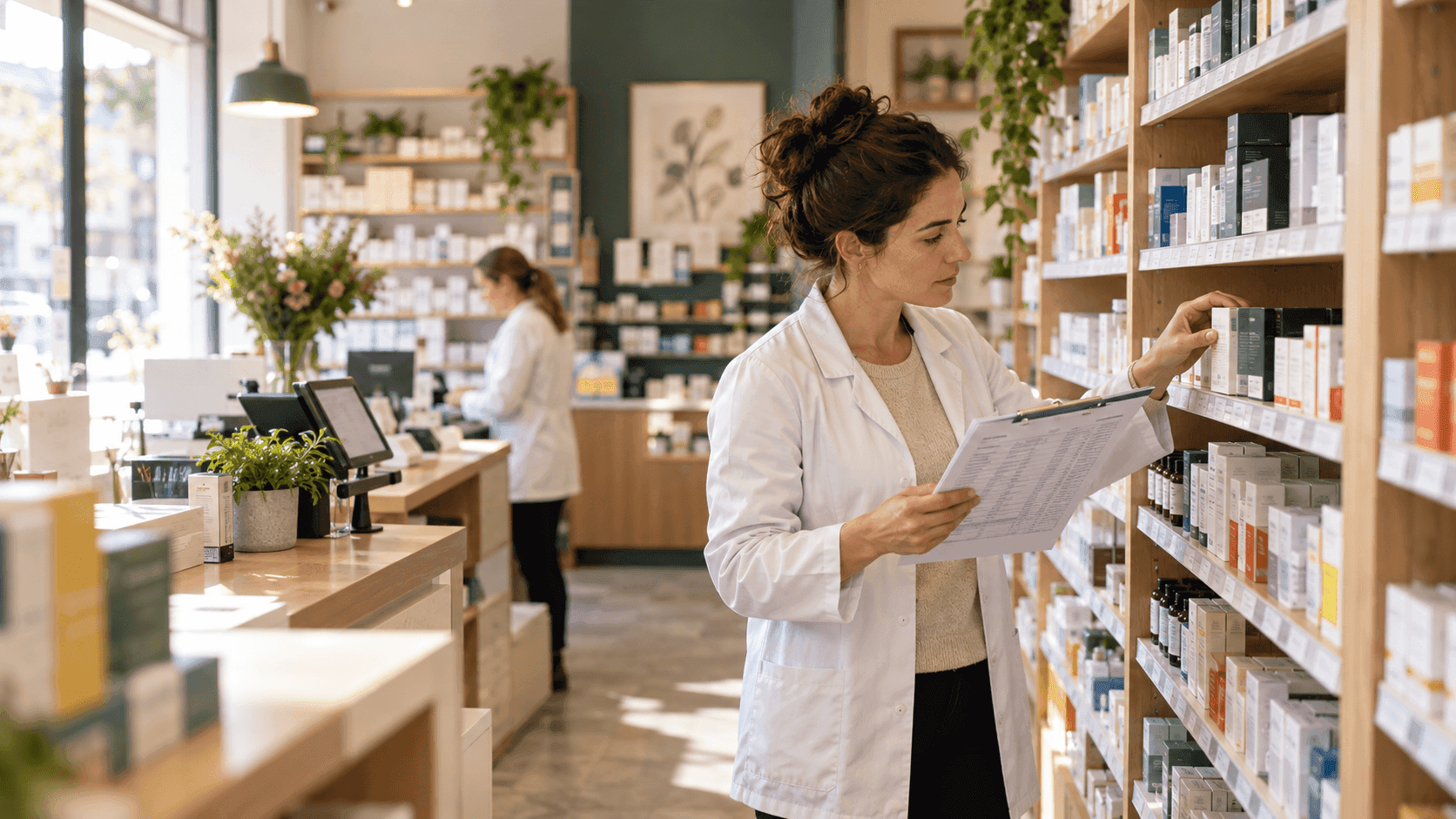
Ethnographic research in pharmacies across Belgium, France and the UK followed the ordering task from start to finish. A pharmacist might print an alphabetical report from the point-of-sale system, walk the shop floor with a clipboard to check what was on display, visit the stockroom, then calculate what needed replenishing. That observation changed the design. Instead of leading with a catalogue browsing experience, the system followed the pharmacist’s stock-led process and provided routes for the three main ordering styles identified in the research. These included repeating previous orders and working from spreadsheet data. The redesign also changed what the website was for. Ordering remained essential, but the platform could help the supplier sell through relevant volume offers and suggestions to try other products or variants within a range. Professional learning and in-store support connected those offers to the pharmacist’s work. For example, completing a smoking cessation course could lead to an offer to stock relevant products, together with patient leaflets, posters and counter displays. The platform brought ordering, education, product information, marketing materials and account services into one experience. The technical build delivered that connected design, supported by a launch film whose language elements could be adapted for different markets.
Result
The direct channel recorded $21m in sales across Belgium and France in its first year, alongside sales growth of 17% in Belgium and 4% in France. The project demonstrates the value of observing how independent partners work before designing a digital sales model. It replaced a familiar but poorly suited shopping concept with an ordering experience grounded in pharmacy practice, then connected it to the services and incentives that supported direct selling.